

Crisis management by the federal government
The German government offers German companies political protection for their projects abroad. German companies benefit directly from the political and economic relations of the Federal Republic of Germany worldwide when they encounter difficulties with sovereign authorities abroad. Targeted support at the diplomatic level helps to ensure the continuity of projects and has a high success rate in preventing losses. In the last ten years alone, the coverage volume of “rescued” projects amounted to over 1.5 billion euros.
From the perspective of investors, the support provided by the federal government in the event of a crisis constitutes the key added value of the Federal Government's investment guarantees. Private investment insurers do not have comparable diplomatic options at their disposal.
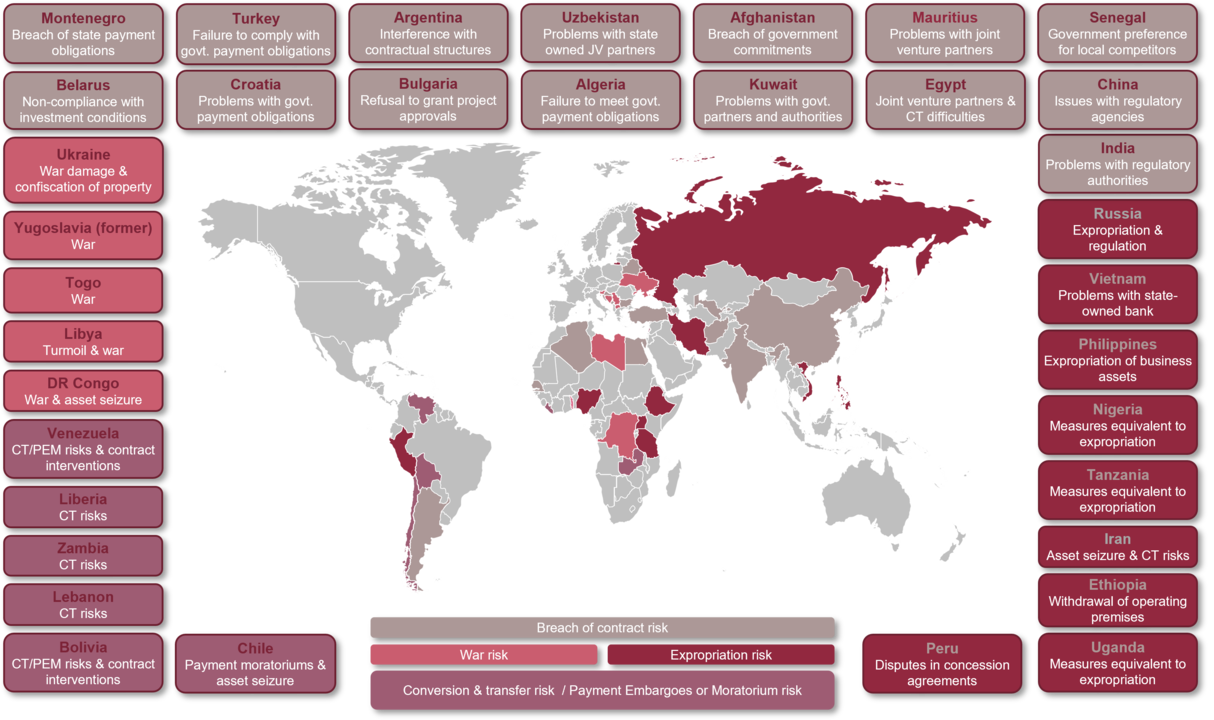
In recent years, the framework conditions for projects worldwide have noticeably deteriorated. Still unresolved trade conflicts, the rise of nationalist forces, Russia's war of aggression against Ukraine and finally, the current crisis in middle east are posing a major threat to foreign direct investment due to political risks. In addition to the need for support especially resulting from Russia's war against Ukraine, crisis management of the Federal Government recently focused on secured projects in Algeria, Egypt, India, Iran, Kuwait, Libya, Peru, and Senegal. Most recently, the German government was able to successfully support a project in Egypt with the intensive involvement of the embassy of the Federal Republic of Germany, thereby averting damage.
Political Risk Report 2025 (Marsh):
- Greater trade fragmentation may increase the risk of conflict, as a less interconnected world offers fewer disincentives or constraints to conflict.
- Conflicts are occurring nearly twice as frequently as they did in 2005, and the number of international sanctions has increased by 370% since 2017.
- As the global trade architecture continues to evolve, geopolitical risks are also expected to exacerbate operational risk management challenges for organizations.
- Organizations may encounter operational difficulties exacerbated by their exposure to political risks, including conflict, volatile supply chains, and proliferating investment regulations. The report examines these risks and explores methods to strengthen resilience.
Political Risk Survey 2025 (Willis Towers Watson / Oxford Analytica):
- By 2024 and 2025, the nature of political risk had changed unrecognizably compared to only eight years before. Political risk was no longer something that happened primarily in high-risk sectors or high-risk countries; indeed, as of 2025, it was more likely to be “geopolitical” than merely political.
- Events such as the war in Ukraine and the Middle East have therefore heightened awareness and concern about political risks in recent years.
- 74% of respondents to our survey said that political risk was among the top five risks on the organization’s risk register; for 11%, it was the number one risk. The proportion of companies saying that they proactively monitored geopolitical issues rose from a bit more than 60% in 2021 to nearly 90% in 2025.
PwC’s 29th Annual Global CEO Survey 2026:
- Looking ahead to the next 12 months, the CEOs surveyed are significantly less confident about the short-term growth outlook for their companies due to the risks posed by geopolitical conflicts.
- 32% say geopolitical uncertainty is making them less likely to make large new investments.
- The CEOs surveyed cited macroeconomic volatility, cyber risks, and geopolitical conflicts as the top threats.
Federal crisis management / Losses from investment guarantees worldwide (as of December 31, 2025)
The federal government has various options available to support companies experiencing difficulties with foreign projects:
- Fact-finding by German embassies and consulates general
- Address by German ambassadors to high-ranking representatives of the country
- Discussion in international committees (e.g., Berner Union)
- Discussion by federal ministries at meetings/negotiations
- Verbal notes from the federal government and letters from federal ministers
- Personal address by the highest political level (e.g., federal chancellor)
Current examples of successful crisis management
China
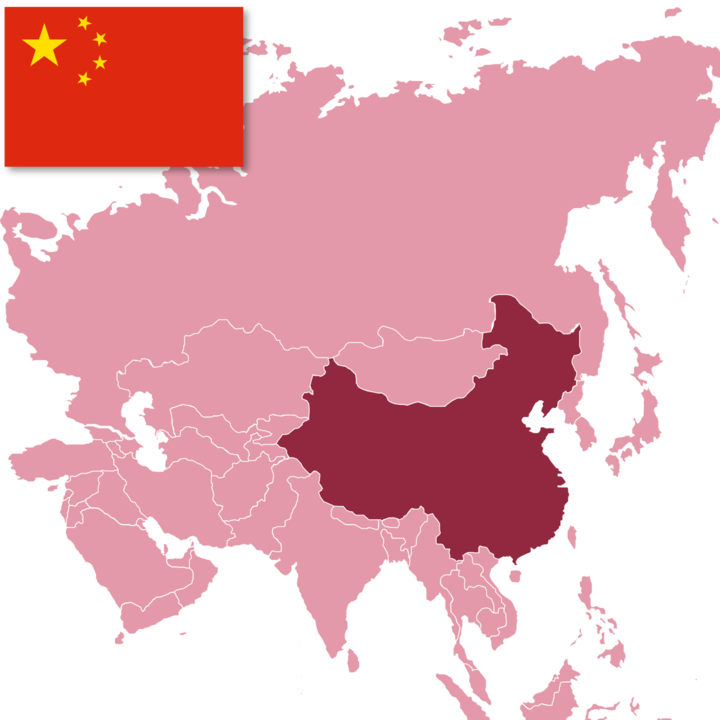
Project subject: Transport and logistics
Project volume: Approximately EUR 150 million
Difficulties: German investor forced out of project and breach of contract by state-owned joint venture partner
Crisis management: Intensive support from German federal government / multiple interventions at highest political level by German Chancellor
Success: German investor receives appropriate payment for withdrawal from project
TÜrkiye
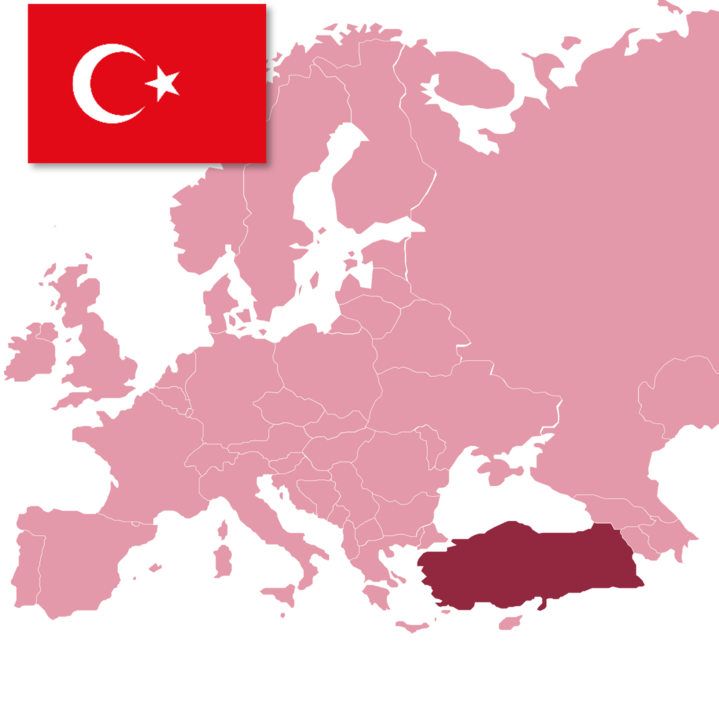
Project subject: Power generation
Project volume: Approximately EUR 775 million
Difficulties: Failure to meet government payment obligations
Crisis management: Letter from the German Minister of Economics to the Turkish Minister of Finance
Success: Payments resumed and arrears settled
EGYPT
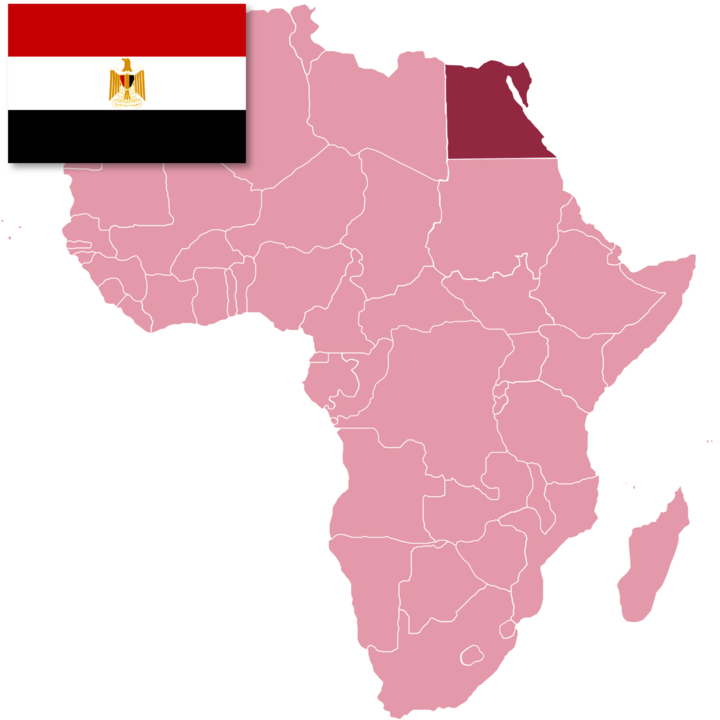
Project subject: Other Services
Project volume: Approximately EUR 8 million
Difficulties: Conversion and transfer
issues (dividends and necessary
imports) / Contract disputes with the government client
Crisis management: Embassy facilitated and supported high-level engagement with the Egyptian government
Success: Successful conversion and transfer / Resolution of contract disputes